Cards of Fractured Beginnings
Plays in browserThe reality is falling apart. Close the fractured timelines at the card table.
Play Cards of Fractured Beginnings
WindowsMacPlays in browserFree to play
About this game
Cards of Fractured Beginnings is a roguelike card game about holding reality together, one card table at a time.
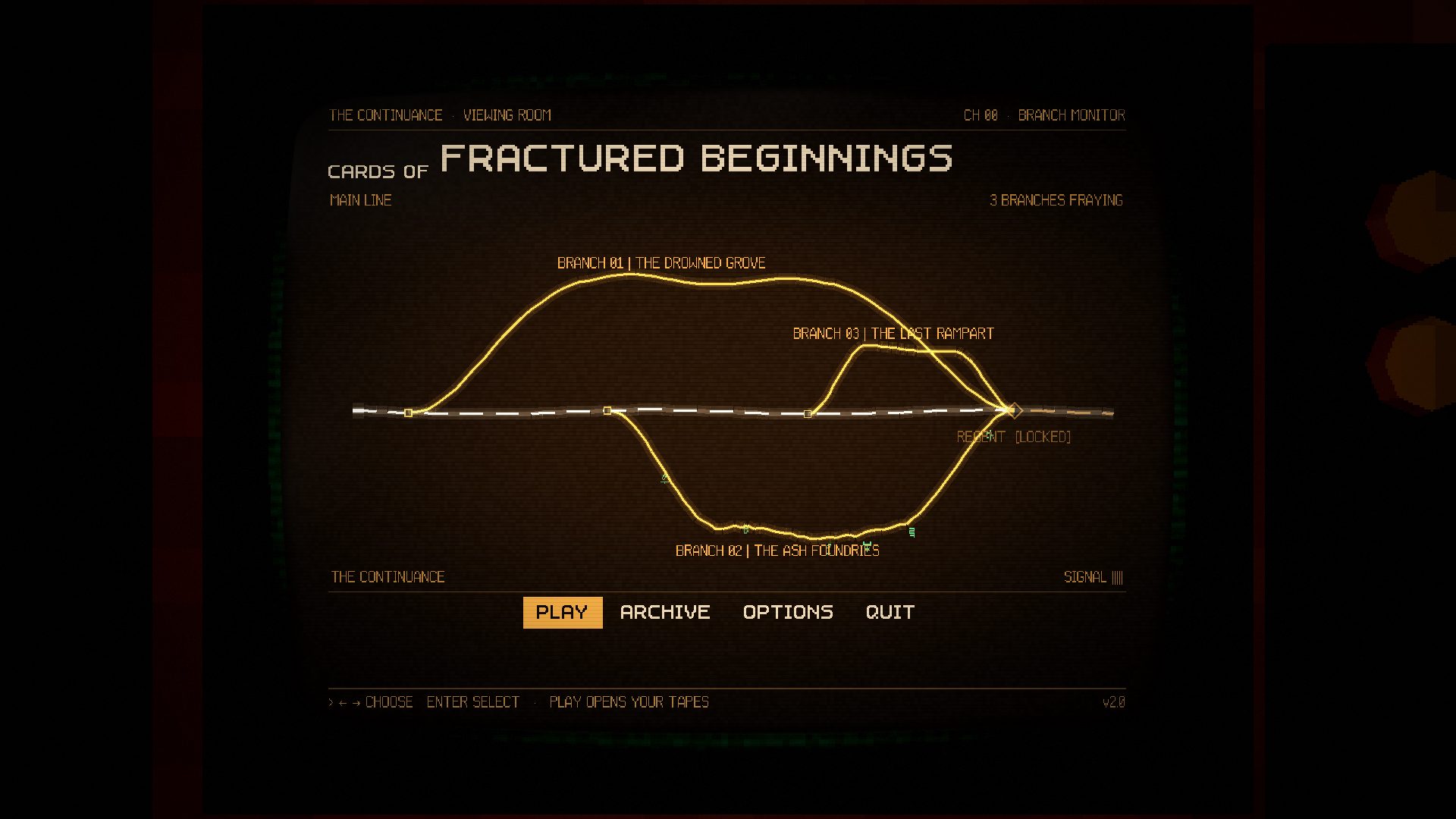
Welcome to the Continuance. We keep reality tidy. Reality, unfortunately, keeps branching, and three of its branches have started to fray. Someone has to go in and settle things. That's you, a field agent with a deck of ten cards, a flip phone and a desk in the Viewing Room, an office full of old televisions, each one showing a world that might not last the week.
Every world is settled the same way: you sit down at its table and beat the locals at cards. Close all three branches, and a masked figure invites you to one last game.
HOW A RUN WORKS
A run is three worlds, played in any order you like, followed by a final match against the Masked Regent. Choose a branch on the timeline, or pick a TV straight from the wall, and the camera dives through the glass into its world:
- The Drowned Grove: a sunken chapel swallowed by roots and rising water. World law, Undergrowth: back-row cards get +1.
- The Ash Foundries: an iron canteen hanging over the furnaces. World law, Forge Heat: front-row cards get +1, but heavy hitters (printed power 6+) get -1.
- The Last Rampart: a guardhouse taproom with a siege burning below. World law, Shield Wall: a card with a friendly card directly behind it gets +1.
The first world you enter is the gentlest. The second and third send sharper opponents with strengthened cards, so the order you choose is your first strategic decision.
You start with three hearts and can hold up to five. Every round you lose costs a heart. Lose your last one and the run is over. Runs take about 25 minutes.
THE TABLE
Each side has a 3x3 grid: a front, middle and back row. The rows form three lanes. Your front row fights the opponent's front row, middle fights middle, back fights back.
A round goes like this:
- A law and an unstable lane are revealed. The law is a special rule that applies only in that lane this round.
- Both sides draw seven cards.
- You take turns placing one card at a time until each side has four on the table.
- The hidden final card: both sides choose their fifth card and its field at the same time, face down. Both flip together, and the round is scored. Every round ends on a guess.
- Carry one: keep one of your two unplayed cards for the next round of the match.
Win a lane by having the higher total there. Win more lanes than your opponent to win the round. If the lanes are split evenly, whoever won the unstable lane takes the round. The margin never matters: winning one lane by a single point counts as much as winning it by twenty, so spreading your strength well beats stacking one row.
WHERE YOU PUT A CARD MATTERS
Cards don't just add their power. Most of them reach into other fields:
- "+2 to the friendly card directly behind it"
- "-1 to every opposing card in its column"
- "+3 if it is in the front row"
- "-2 to the opposing card in its mirrored field"
Effects count in the lane of the card they touch, so a card standing in your back row can quietly win the front lane for you. Placing or removing a card changes the totals instantly, and the board shows every bonus and penalty as it happens.
On top of that, cards have tags (Grove, Tide, Ember, Machine, Spirit) that like or dislike each other when they share a lane. Grove and Tide help each other. Ember and Machine work well together. Spirit and Machine do not get along. A lane full of friends can outscore a lane full of bigger numbers.
LAWS
Each round one law takes over the unstable lane, and it can flip a whole plan:
- Small Wonders: cards with printed power 3 or less get +2.
- Titan's Due: cards with printed power 5 or more get -2.
- Convergence: a side gets +3 if its cards there have three or more different tags.
- Bloodline: a side gets +3 if at least two of its cards there share a tag.
- Solitude: a side with exactly one card there gives that card +2.
- Mirror Tax: a card gets -2 if the same card stands on the opposing side.
- Edge of Reality: the left and right columns get +1, the centre column gets -1.
At a shrine you can join two laws into one, and both effects apply together. When the world frays far enough, every round's law arrives already joined with a second one.
FUSION
This is where your deck becomes yours.
Any two cards can be fused into a brand-new card with its own name, art and ability. It keeps both tags and both abilities, each working on its own fields, and its power is the average of its parents. Fuse two copies of the same card and its ability becomes twice as strong. Cinder Hound and Orchard Witch become the Orchard Firehound. Two Ash Duelists become the Ashbound Champion.
With 15 base cards there are 120 possible fusions, and every one has its own name and art. The Fusion Atlas in the Archive catalogues each one you discover.
Fusions get better with marks. When you win a round and the unstable lane, every card of yours standing in that lane earns a mark, which it keeps for the rest of the run. Fuse one marked parent and the result gains a star (+1 power). Fuse two marked parents for two stars: +1 power and every effect one step stronger. Playing the unstable lane well now pays off later.
YOUR ROUTE: THE FLIP PHONE
Each world is a four-step route, and your phone shows it as a small glowing tree that opens up in 3D on its screen. Every step offers two or three places to go:
- Skirmish: a single round against a local echo. Win and choose 1 of 2 cards.
- Elite (skull): best of three against a dangerous visitor, like a dragon far too big for the room. Win for 1 of 3 cards and less fray.
- Hearth: restore a heart.
- Shrine: join two laws into one.
- Cache: take a free card, at the cost of more fray.
- Seam: only opens once the world is fraying. A round against an echo from another world, for its cards.
- Keeper: the world's guardian waits at the end of every route. Win two rounds to close the branch.
Each echo has a habit printed on its card. One draws an extra card, another always avoids a lane, another wins every tied lane. Read them before you sit down.
Some keepers bend the rules of their own table. The Hollow Chancellor promises a lane each round and boosts his cards there, but if you take it from him, his other lanes weaken. The Hoarding Wyrm gains fury for every lane it loses, then erupts with an ignited card. The Oathsworn Knight vows where his next card will land, and keeps his word.
FRAY: RISK AND REWARD
Fray runs from 0 to 5 and measures how far your branch is coming apart. Taking caches, skipping elites, drawing rounds and greedy choices raise it. Winning elites and seams, and beating a keeper without losing a heart, lower it.
A frayed world is harder and more generous:
- At 2, seams start opening on your route.
- At 3, every law comes joined with a second law, and every reward offers one more card to choose from.
- At 4, the locals' strongest cards get stronger.
- At 5, the Regent starts the final match with one of your lanes already sealed.
THE STOP: CLOSING A WORLD
Beat a world's keeper and everything happens on one board on the table: take a reward card, swap cards between your deck and reserve, and fuse two deck cards by dragging one onto the other. Then make the big choice:
- Mend: lower fray by 1 and restore a heart.
- Grow: raise fray by 1 and take another reward card.
The room around you shatters, and you're back in the Viewing Room choosing the next branch.
THE MASKED REGENT
Close all three worlds and the televisions turn gold. The Masked Regent waits in his War Room with a deck made entirely of fused cards. He chooses the law and the unstable lane every round, and the first round he wins, he seals one of your lanes for the rest of the match. Beat him twice to win the run.
A NEW BEGINNING, EVERY RUN
When a run ends, whether you win, lose or walk away, you choose what to carry out of it. Preserve up to three of the cards you earned or fused, and they join your collection for good, stars and marks included. Build your next deck from them and start again, never quite from nothing.
The Archive remembers everything: cards held, fusions made, laws joined, opponents beaten and worlds closed. Discoveries earn points toward fifteen commendations, which unlock new card backs, tablecloths, a starting deck for each world and hints in the Fusion Atlas.
FEATURES
- A roguelike card game with short, tactical 3x3 grid battles
- 120 card fusions, each with its own name and pixel art
- Three hand-built worlds, each with its own room, law, locals and keeper
- Opponents with their own habits and table-bending powers, and a final masked rival
- Route planning, risk and reward with fray, and the choice between Mend and Grow
- The Fusion Atlas, the Archive, commendations and unlockable cosmetics
- Three save slots: save and leave at any time, and continue later
- A short guided lesson with the Keeper of the First Table (skippable)
- Pixel-art 3D characters and rooms, CRT television menus and a flip phone that actually opens
- Full mouse and keyboard play
CONTROLS
Mouse: click a card, then an empty field. Right-click goes back. Right-click and hold a card to inspect it. Keyboard: arrows or 1-7 choose, Enter places, I or Shift inspects, V shows the law, T views the board from above, Esc or Tab opens the phone.
CREDITS
A game by lobatim. Built on the Godot Engine 4.7 (MIT license, (c) Godot Engine contributors) and exported with Summer Engine.
AI disclosure: the code, card and character art, music and sound effects were created with the help of AI tools, and all of them were generated specifically for this game. No third-party asset packs were used.